Tuesday, November 17, 2020

D. I. Y. H. (DESIGN-IT-YOURSELF HISTORY)

Whatever percentage of you actually include some of your attention to historic buildings via for-sale-announcements may have become aware of a sale, current at the time of this post, of a house on Franklin Boulevard.  The announcements claim that it was built in 1872 for Frederick Pelton, Cleveland's Mayor at the time.  Nothing could be further from the truth.  An easy search of City Directories circa 1872-3 shows that Pelton, in fact, lived on West 25th Street.  Pelton never even owned this property.  [He did own property immediately to the west around this time.]  This house, in fact, was built in 1879 for banker Ceilan M. Spitzer. This has been well-researched, definitively proven by historical [not contemporary] real-estate tax records.

1995 photo by C. B.

The erroneous account can be traced at least as far back as 2002, when this house was included in the Ohio City Home Tour and its owner, interviewed by the media, gave this very account.  Apparently, whatever research was done by her, or someone acting on her behalf, misinterpreted the Pelton ownership of the property next door as her property, which then led to other conclusions not relative to her property.  Ironically, shortly after those interviews were published, she did finally learn of the correct history of the construction of her house -- which was unfortunately never published.  And, now, with two owners beyond her, the factual history of this house has fallen through the cracks.

Since we are talking of this house, and what is factual versus what isn't, another myth associated with this house is the claim that a local attorney named James Dempsey owned and occupied this house in the 1880s.  This is only half-true.  John Dempsey, the father of James Dempsey and not an attorney, owned this house.  His son, though, did reside there as well, but only for a few years.  Also, the elaborate Gothic Revival fussiness seen in the gable of the front porch today, and what at a glance might appear to be 'hoods' over some of the house's windows, were added around only 20 or so years ago.  There was no evidence supporting that the porch had ever been this ornate, and there is even some circumstantial evidence that it had been fairly simple in appearance.

If the "former mayor's house" story leads to a sale, let's hope the new owner doesn't become too attached to this story.

[For anyone with a much deeper interest in this house, please see the story on Cleveland Historical:  https://clevelandhistorical.org/items/show/917 ]


Friday, December 28, 2018

The TRUE story of the "Franklin Castle"

One of the most known and recognizable structures in what is considered Ohio City is the Tiedemann House [more commonly known as "The Franklin Castle"], located on Franklin Boulevard.  It was built in 1881 from designs supplied by Cleveland architectural firm Cudell & Richardson.

A very extensive article was written about this house and its owners and occupants by William Krejci, which was published in the Spring 2010 issue of The Argus, a short-lived newsletter devoted to more historical topics pertaining to Ohio City.  We are now re-publishing this article, LITERALLY as it appeared in The Argus.  This is the most that has ever been written about this house and who used it.  It would be a major challenge to surpass it.  Please excuse its abnormally large size on the page.


Tuesday, June 6, 2017

UNHINGED IN HINGETOWN

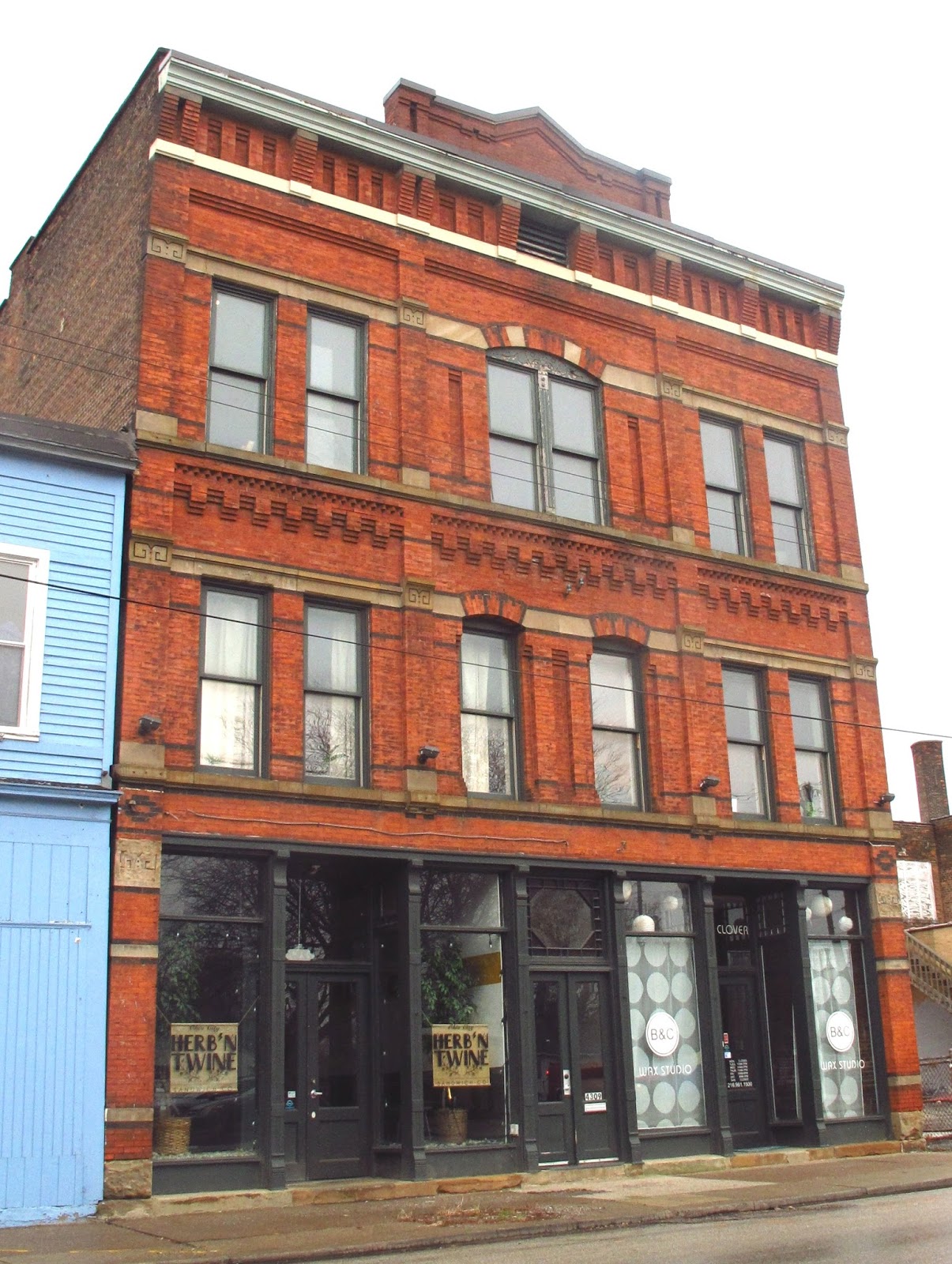
Please note the image above, which shows a commercial building -- or more specifically a rear perspective of such -- located in the north east corner of Ohio City.  This photo was taken this past winter.  Particularly note the wall "treatment" on the rear wall.  Apparently the "threadbare-rug" look is being suggested as the next exterior-wall-covering trend.  This almost makes one want to wish for a revival of aluminum siding (not that it could have been successfully attached to a masonry building like this, but, on the other hand, how did they get all these discarded rug fragments to adhere to the building?). This 'modern' form of 'abstract' expression can, perhaps, be expected in this particular 'enclave'.  Much like Key West having once tried to be a sovereign nation called the Conch Republic, it appears that a few of the business owners in this section have been trying to convey that, suddenly, this section is no longer part of Ohio City -- hence coming up with a name that seems like it ought to belong to a specialty hardware store.  Perhaps applying a few more "avant garde" decorating schemes to more of the nearby structures will cause Ohio City, out of embarrassment, to 'disown' this section.  (Was this the devious plan, all along?)  Hey -- what about covering the next building with discarded, bald tires???
                                                                                                                                                       -- C. B.

Sunday, January 29, 2017

HOME TOURS FOLLIES #3 & #4

The 2010 Ohio City Home Tour contributed a two-for-the-price-of-one folly deal.  Both were related to buildings on the tour that were not homes, but businesses, instead.

One, a three-floor building on the primary business thoroughfare, had included in its tour description a reference to the "...third-floor ballroom of the Odd Fellows Society in the late 1870s".  First of all, the Ohio City chapters of the Odd Fellows [the International Order of Odd Fellows was its actual name, by the way] were actually occupying a brand-new (1873) structure, built specifically for them, in a different part of Ohio City.  Second of all -- and this is clearly more significant -- this structure wasn't even built until 1884 (for a man named Leonard Maurer, to the designs of local architect Andrew Mitermiler, for those who may wish to know such 'minutiae').

The other structure was built for an organization known for its devotion to providing physical exercise for its membership.  Located on what had long been the premier residential avenue of Ohio City, which had finally faded and was then beginning to see institutional use usurp the residential, the tour description alleged that the structure was "...built in 1901...".  It would seem that someone had merely looked for the institution at this location in the historic city directories.  They did, indeed, first appear at this location in 1901, but, it was inside of one of the old grand dwellings.  After constructing a gymnasium addition at the rear of the dwelling, it wasn't until ten years later, in 1911, that the structure on the tour was built, replacing both the dwelling and the gymnasium addition.

In a later Ohio City home tour [we've misplaced what year it was], included was another business, inside of a commercial building, on another primary thoroughfare that historically had been overtaken by commercial development.  Within the tour description, there was a reference to the "...earlier portion of the building from the 1850s...".  It is very much true that there is an earlier portion of the building, but it certainly is not from as far back as the 1850s.  It was actually built in 1869, and there was even at least one newspaper account in that year about this very event.  Its owner, Henry Heil, was considered a significant citizen.  The design was provided by local architect Henry E. Myer. 
                                                                                                                                                     -- C. B.

Thursday, June 23, 2016

HOME TOURS FOLLY #2


One of the buildings on the 2000 Ohio City Home Tour was 2070 West 41st Street.  In the brief accompanying description in the tour booklet for this house, it claims it is an "1880s home" and was "built in the 1890s".  This is quite remarkable to discover a structure that doesn't have merely one age, but two!!  Sadly, though, neither of these is correct!  It, in fact, was built in 1903 [sorry -- no additional times].  Its original owner and occupant was an Albert Fischer.  One of the other stories found in the tour booklet description is about a house-to-house intercom that had once existed between this house and a now-demolished neighboring house. There seems to be grounds to at least make this story believable. If true, this could have been used by Fischer to communicate with his neighbor and partner in a real-estate firm, Louis Litzler (who also happened to be married to one of Fischer's daughters), who resided in the now-demolished house.  [Note: A new house has since been built on this neighboring lot.]
                                                                                                                                                     -- C. B.

Wednesday, March 23, 2016

HOME TOURS FOLLY #1

Some of you out there are familiar with the Ohio City Home Tour events that went on yearly for many years in Ohio City.  These events were most likely the largest source of historic mis-information regarding Ohio City that ever existed.  There is hence going to be an entire "series" of posts here whose intent will be (of course!) to expose the "folly" of  these many wild -- and sometimes absurd -- falsehoods regarding some of Ohio City's historic structures.  They will appear here in no particular "order".

The 1999 Tour included the house at 4721 Franklin.  When a tour-goer got to that house, you were handed a separate sheet with additional information.  Within this were a few comments about the apartment building immediately to the west.  Included was a statement that the apartment building was constructed for Henry Brooks, who had been the owner and occupant of 4721 Franklin.  It further stated that the apartment building had been constructed in 1915.  Neither of these statements are factual.  It had been constructed in 1906 for a man named James Aitchison, who lived in a house directly behind it on West 48th.  In fact, it had been originally known as the Aitchison Apartments.  Henry Brooks had nothing whatsoever to do with the construction of this building.  The building appears on 1911 and 1912 Sanborn fire insurance maps and on the 1912 Plat Book for that part of the city, all of which can be viewed at Cleveland Public Library and elsewhere. Claiming this building wasn't constructed until 1915 only demonstrates how no attempts were made to look at historic maps like these which showed the buildings.  Claiming that the building was constructed for Henry Brooks only demonstrates how no attempts were made to look at historic property records, available at the County Archives (located only a handful of blocks from here).

Additionally, ads appeared in the local newspapers as soon as these apartments were ready for occupancy.  Many showed an illustration of the building, but at least one used an actual photograph.
FEBRUARY 1907
Note the crenelation at the top of the bay at the corner of the two streets.  This has since been removed.  Also note the house directly behind the Aitchison -- the residence of its owner, James Aitchison -- removed to create parking for the apartment residents (!).

-- C. B.

Friday, October 9, 2015

FOLLY-ING AND "ARTISAN"-MONGERING -- THE PERFECT COMBINATION!


One of the most extraordinary follies of Ohio City does not even pertain to a structure.  It pertains to an organization.  The community development agency that services this part of the city seems to be trying to suggest that it is among the oldest corporate entities in all the Cleveland area.  Having recently changed their name, accompanying their new logo is the line “Est. 1836”, which would mean that they were established almost 180 years ago.  


This is the epitome of nonsense.  This organization, even if considering any group that might be legitimately considered its predecessor, was established in 1968.  It is true, of course, on the other hand, that the historic municipality of Ohio City, prior to its annexation to Cleveland in 1854, had incorporated as a city in 1836 – but certainly there is no connection between the city that ceased to exist over 160 years ago and this modern-day community development agency.  The inclusion of “Est. 1836” as part of its corporate identity is not only extremely false historically, it is misleading, particularly to tourists and even local residents, who would be unfamiliar with local historic facts.  Its use should be ended.

Of course the irony is that the agency's newest name change uses the historic year "1836" (none of the earlier titles of that same organization had any historic reference other than “Ohio City”), yet the present agency no longer has any real interest in preservation.  Under past names, the agency promoted Ohio City as "Cleveland's Premiere Historic Neighborhood."  The agency's current goal is not to promote the neighborhood's rich historic heritage, but to "brand" the area as the land of the trendy artisan.  (This, by the way, is pretty much the same branding used in Tremont, Detroit-Shoreway, Northeast Shores, and Little Italy – in other words, nothing distinctive here.)

-- C. B. & Tim Barrett